
Designing Komyut: building trust into a ride-sharing app for Lagos
Sharing a car with a stranger is a trust problem before it is a technology problem. Here is how we approached the product design for Komyut.
By CQube Tech
Every weekday, thousands of cars travel from Ajah, Lekki and Ikoyi to Victoria Island with empty seats. At the same time, thousands of people on those same routes are paying for expensive solo rides or squeezing onto crowded buses. Komyut exists to connect the two: drivers publish the route they are already taking, and riders book an empty seat and split the fuel.
It sounds simple. But getting into a stranger's car is not a technology problem first. It is a trust problem. Most of our product decisions came back to one question: what would make you comfortable doing this tomorrow morning?
Start with the route, not the map
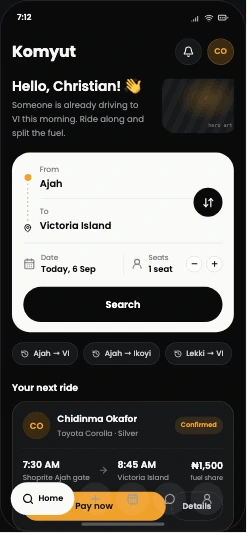
Most ride apps open on a map. We started with the route instead. Commuters in Lagos think in corridors ("Ajah to VI", "Lekki to Ikoyi"), not in pins on a map. So the home screen leads with a simple From → To card, a date and a seat count, with recent corridors one tap away underneath.
It's a small change, but it means a returning rider can find tomorrow's ride in about three taps.
Make the cost obvious
Price anxiety kills conversions. On every ride card, riders see the fuel share in Naira, along with departure and arrival times and the pickup point. It is clear what you pay, when, and where, before you even open the details.
For drivers, an earnings screen shows what their empty seats have earned that week. That turns an abstract idea ("share your car") into a concrete benefit.
Trust is a feature, not a footnote
We designed trust into the core flows rather than adding it at the end:
- Verification. Drivers and riders verify their profiles, and a badge shows who has done it.
- Route review. New routes go through a short review before they're published, which keeps out low-quality and suspicious listings.
- In-app chat. Riders and drivers coordinate pickups without sharing phone numbers.
- Ride confirmation. Both sides confirm a completed trip, so there's a clear record of every ride.
Break publishing into small steps
Publishing a route has a lot of inputs: route, stopovers, schedule, vehicle, seats and price. A single long form felt like filing taxes. We split it into six short steps with a progress indicator and a final review screen. Each step asks one question, so the whole flow feels quick even though it gathers a lot of information.
What we learned
- Design for the corridor. Local mental models beat generic patterns.
- Show the money early. Clear pricing builds confidence.
- Trust needs to be visible. Badges, reviews and confirmations reassure people more than a policy page does.
Komyut is in active development. If you commute in Lagos and want early access, join the waitlist.